


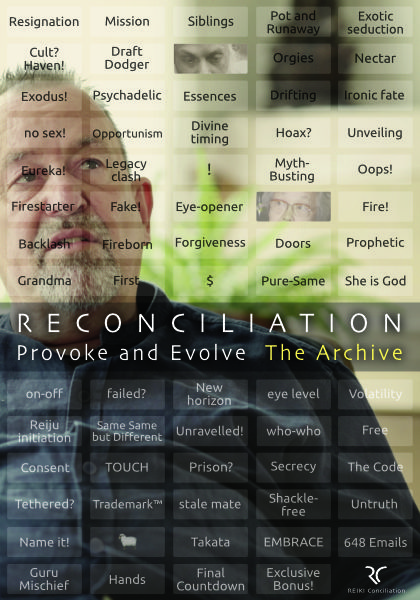
01. Resignation from Jikiden – Why and What now?
Frank Arjava Petter resigned from Jikiden Reiki. We were the first outsiders with whom he discussed this sensitive topic on January 7th, 2025. This breaking news would influence the ensuing interview.
We discovered that Arjava had asked Bert Hellinger to make a constellation for Reiki already in 2000. The session is on video: A67 Reiki Constellation with Bert Hellinger (2000)
02. Mission Statement
The overall purpose of and spririt behind this project: to look at the past, to reconcile in the present, to liberate the future. This video describes the agreement between the producer René Vögtli and the interviewee Frank Arjava Petter.
This video describes the agreement between the producer René Vögtli and the interviewee Frank Arjava Petter.
03. Carefree Childhood
Arjava’s sister, Cornelia, was the family’s first born. She died as a baby. The father, traumatised in WWII, is plagued by nightmares. Yet, the parents provide for a protected childhood with much freedom. The second born, Martin, who would play an important role later, is the only one still alive today.
Recollecting the trauma of their fathers after WWII leaves Arjava and René wondering about the world today.
04. Rebellion, Disaster, Vision
Arjava’s rebellious streak got him expelled from High School. His parents did not give up on the troubled boy and enrolled him in a private school. There, his sense for uprightness got him kicked out again.
Experiencing police brutality and following his teenage dreams, which are accentuated by smoking pot and the longing for spiritual answers, Arjava decides to run away from home. In the ensuing disaster, he discovers mystical and spiritual literature, culminating in Paul Reps’ books about Zen Buddhism.
05. Exotic WomenExpelled from SchoolYoga and Farming
Seeing a beautiful Japanese woman awakens dreams of Japan in Arjava. He is impressed by the calmness of a friend’s father who insists on rigid rules befrore introducing Raj Yoga to the youngster.
After getting thrown out of school, he speaks to the most prominent advocate of organic farming at the time, only to be told to start an apprenticeship in industrial farming first. This would teach him what to do – and what not to do – in the future.
06. Saving Himself and Becoming a Disciple of Osho
An adventurous journey on the Hippie trail brings Arjava’s brother to Poona in India, where he becomes a disciple of the notorious Bhagwan Shree Rajneesh, aka Osho. Meanwhile in Germany, the family worries that he might have become the victim of an insane cult.
18 years old, Arjava travels to India to save Martin, now known by his Sannyasin name Raj. Unexpectedly, the ashram turns out to be the place of Arjava’s yearning. An ‘intensive enlightenment’ reveals to him the belief systems about oneself and how illusionary they are.
Arjava meets Osho personally for the first time before returning to Germany – without his brother.
07. Objecting Army Duty – Escaping from Social Service
Back in Germany, Arjava has a dream of his guru, after which he stops his farming apprenticeship. This is the first time in his life that he stops doing something he loves. The second time is now in 2025, resigning from Jikiden.
Arjava objects army duty on pacifistic grounds. In front of a commission he recounts his father’s nightmarish screams as a result of the war trauma. He should now do social service for 1 ½ years. Instead, he escapes to India. On the way his guru is mistaken for Karl Marx.
08. Life at the Ashram – a Pressure Cooker
The ashram is like a pressure cooker. It is a place where buttons are being pushed and situations are used to get one out of one’s comfort zone.
Arjava, still a kid really, neither takes part in psychotherapeutic encounters nor does he join sex orgies. Instead he participates in a 10-day Vipassana meditation.
The book in René’s hand during the question recounts life in Poona and the USA with and around Osho. (Still … Here and Now, 2022).
09. The Master’s Gardener Holds a Wisdom for Life
A Greek lady takes the youngster Arjava under her wings. Yet, the trained gardener is to collect leaves – an exercise to delve into consciousness. Sex and drugs may be good for exploration but at the end, one has to find one’s own nectar inside.
Arjava becomes Osho’s gardener and an assistant presents a piece of wisdom to him that would become a leading principle for the rest of Arjava’s life, affirming the effort to do one’s best at any given moment.
10. Deserted, Sick and Facing Jail – Social Service Provides Shelter
Weak with Hepatitis, Arjava learns that Osho has left overnight to USA. America is out of reach and in Germany a jail sentence hangs over him. With the help of a former policeman his desperate odyssey ends in Germany. He is pardoned but has to do social service for 18 months helping the elderly and needy.
Then, just as his social service ends, he receives a letter from the infamous Sheela, Osho’s powerful secretary: „We need help in our new community. Would you come and join us in Oregon?”
11. The Elusive Guru Triggers
Osho gets deported from USA. Arjava and his American girlfriend Lino prepare their own flight from the ranch. They follow their elusive guru around the globe.
Back in India, they end their relationship. Heartbroken over yet another love story, Arjava gets consoled by Chetna, his future Japanese wife.
Arjava becomes Bill Gates’ gardener in the USA before Chetna and he return to Poona once more. Osho introduces the Mystic Rose Meditation, a transforming experience. Arjava quits gardening and becomes Osho’s body guard.
12. Essence of Osho versus Essence of Reiki
The essence of Osho’s teaching – quite in union with the 5 Reiki precepts – focusses on being in the present, not past or future.
Osho is catalysing a dismantlement of ego. That in turn is a spiritual experience, which leads to wanting to share one’s own experience with others.
The spiritual path of Reiki is leading to the same end.
13. Search for Meaning Across Borders
Arjava and Chetna visit to Osho for the last time, he dies less than an year later. They journey to Japan, with cultural challenges, visa issues, and odd jobs, before returning to Germany. There, an unexpected opportunity leads Arjava into TV crime-drama production. Eventually, Arjava and Chetna move back to Japan to start a language school.
An honest, humorous tale of adaptation and self-discovery across continents.
14. Tokyo → Berlin → Tokyo German re-imports Japanese Healing Art
Traditional healers were part of Arjava’s upbringing. In 1988, a painful headache leads a sceptical Arjava to his first Reiki session. Though unimpressed, something in him stayed curious – his ‘soul was tickled’.
In 1991, while running a busy language school in Japan with his wife, his brother Raj calls from Germany urging him to learn Reiki. Arjava follows the nudge – flying from Japan to Berlin to study a Japanese healing art to bring back to Japan. Ironic, yet fatefully right.
In Berlin, Arjava completes Reiki levels 1, 2 and teacher training in just a few days. Back in Japan, he initiates Chetna, who promptly perceives flaws in the system. Her reaction plants the first doubts in Arjava and sets him off on a mission to eventually uncover the roots of Reiki.
15. Too Close to Teach?
Arjava speaks candidly about ethical boundaries in teacher-student dynamics, sharing how he turned down his future wife as a Reiki student because of his romantic feelings for her. Instead, he encouraged her to learn from another teacher to ensure an authentic, independent experience. His story highlights the importance of integrity and clear roles in spiritual teaching.
The conversation explores teaching close relatives or partners. Using his own children as an example, he says he’d have no hesitation teaching them Reiki, as long as roles and intentions are clearly defined. It’s all about awareness and respect for personal dynamics.
16. Was Reiki Even Japanese?
In 1992, Arjava returns to Japan with doubts about the authenticity of Reiki’s origin. His early exposure to Japanese culture didn’t align with what he was taught. As confusion grows, he suspects Reiki might not be Japanese at all. Yet, he continuously teaches.
Arjava learns he wasn’t the first. Mieko Mitsui had already introduced Western Reiki in the 1980s but made the higher degrees inaccessible to most Japanese people, demanding travel to the USA, language and academic prerequisites, and a significant financial contribution. Arjava benefits from this situation and picks up where Mieko left off, beginning a journey of teaching and historical investigation that would change everything.
17. From Guilt to Guidance
Arjava reflects on his ever accelerating journey into teaching Reiki, starting with ads in Japanese magazines to drawing students from all over Japan. He recalls doubts about the value-for-money he offered based on what he had learnt from his brother Raj. A sense of guilt became a motivator for deeper research, the results of which gradually were introduced in his teachings.
A student demands a good Reiki book and Arjava asks his charismatic brother Raj, who tells him to write it himself. For Arjava this is another reason to explore Reiki and he begins writing what would become his first book: ‘Reiki Fire’
18. Feisty and Abrasive – Yet, She Reveals the Secret
Arjava hits rock bottom in his research on Usui, even doubting his existence. A random van labelled „REIKI” destroys all hopes.
A tip from a student makes Arjava coax his wife to outmanoeuvre Japanese protocol. They call a mysterious and abrasive woman with 65 years of Reiki practice going back to Usui’s time. Mrs Koyama’s rejection of „Western” Reiki implies for the first time the existence of a Japanese practice. Eventually, she concedes and shares key facts about Usui, including his birth date and burial site.
19. Chasing Ghosts – Tangible Discovery
Arjava investigates claims that Usui earned a doctorate in Chicago and that he was president at the Dōshisha University – to no avail. These dead ends begin to shake the foundation of accepted Reiki history, leaving Arjava both sceptical and intrigued.
A clue from the extraordinary survivor of the Usui era points to Saihoji Temple as Usui’s burial site. Chetna reluctantly helps call similarly named temples in Tokyo. Eventually they hear: „Yes, we have him here.” Arjava is ecstatic – after years of rumours and myths, there’s finally a physical trace of Usui. This moment marks the start of a deeper, more tangible journey.
20. The Stone That Spoke
The pivotal discovery of the Usui memorial unlocks long-lost historical insights. A touching moment of curiosity, frustration, and eventual triumph unfolds as a group of friends struggles to decipher pre-war Japanese inscriptions. Through persistence and a little serendipity, the foundational text emerges, becoming a key source for understanding Usui’s life and legacy.
21. Whispers of Silence
Arjava recounts contacting the Usui family via a carefully worded letter, only to be told that Usui’s deceased daughter-in-law’s will forbade any mention of Usui’s name.
Despite this painful injunction a powerful document by Usui surfaces, his ‘mission statement’ as it were. In it he breaks with tradition by making Reiki available for everyone. It may very well hold the seed for Reiki’s future development, but also allows for a chaotic development. Arjava speculates that this may be why Usui became a persona non grata his own family. René brought this up in response to questions raised by the ‘Tokyo Yokoi thesis’ that emerged in 2024.
22. No Wrong Reiki
A serendipitous meeting leads to Arjava connecting with Mr. Oishi, who gifts him a photograph of Mikao Usui. What’s more, he links him to the existence of an organisation founded by Usui and so far hidden away. This opens a door to one of its teachers, Mr. Ogawa, and to insights challenging everything Arjava thought he knew about Reiki.
Arjava describes how despaired he was by the contradictions between what he had learnt and the newly discovered Gakkai information. He gives a preview that the future would hold unexpected developments and he shares one of the most significant messages of the entire interview.
23. Hands Like Waterfalls
Arjava reflects on the trap of unverified Reiki stories and ponders the impossibility of a foreigner being accepted into a traditional Japanese art.
He marvels at Reiki’s purity which is beyond form or lineage and explores Shinto roots of healing, where nature itself is the sanctuary. Reiki practitioners, he says, become the modern equivalents – embodying waterfalls, trees, and springs.
24. Predicament
Arjava discusses his vast personal archive of Reiki documents – digitally organised but kept private. He reflects on not having handed it over to the Jikiden institute and doubts the objective value of the material, viewing this video series as truer legacy.
Blocked from joining the Usui Association by it’s rigid rules, Arjava finds peace through a hands-on exchange with Ogawa Sensei. A healing session opens the door to direct teaching of Japanese techniques, which Arjava later integrates into his own practice.
25. Silenced by Blood
An unacceptable misinterpretation of the Japanese publisher coincides with a pivotal call from Walter Lübeck. ‘Reiki Fire’ finds a surprising home in Germany.
Brother Raj is evasive about his lineage and wants his name erased from the book. This is stunning and the beginning of a fallout of the two brothers which would last for decades. It will also necessitate a new Western lineage for Arjava.
In the book, Arjava opts for a veiled reference to his teacher’s name. The critics respond with antagonistic rejection – while Arjava was hoping for Champagne corks flying over his revelation of long lost historic facts.
26. Painful Truth and Integrity
After ‘Reiki Fire’ is released, Arjava receives shocking news: Raj had made up the attunement process and taught it to Arjava – who in turn taught it to his Japanese students.
In response, Arjava re-trains with his friend Ageh Popat, who trained in Switzerland in 1998 within a verifiable Reiki Alliance lineage. The attunement turns out to be different from that which he had learned from Raj. Back in Japan and with full transparency he contacts his students and offers to re-initiate and re-train them. Not all students return.
The two brothers have never cleared this with each other.
27. Ghosts in the Lineage
Arjava grapples with the legacy of students continuing to teach under his brother’s disputed lineage. He reflects on Hiroshi Doi’s initiation process and his own unintended „grandfather” role in that chain. The records of students from that time are inaccessible after the couple’s contentious divorce. Later developments suggest that Chetna keeps them.
Ogawa sensei presents Arjava with his memoirs ‘Everyone can do Reiki’ and with Usui’s and Koyama’s teaching manuals. Not to be copied! Arjava would later break his vow. Only once! He gifted – and thus preserved – a copy of Koyama’s manual to Chiyoko Yamaguchi. After Ogawa’s death, his family offered his legacy to Arjava, who humbly declined.
28. Polemics, Ridiculing and Apologies
René confronts Arjava with the criticism of seeking fame and fortune with his publications. He also holds him responsible, in his role as a teacher, for students’ inappropriate behaviour.
Arjava recounts the release of his book „Reiki Fire”. He was convinced that to unearth historic new ‘truth’ will do the Reiki community a favour. Instead, he received a severe, unexpected backlash. Somewhat unapologetically, he admits that his humour has caused misunderstandings; but he stands firm by his intention to inform, not to offend.
29. Boycotted but Persistent
Arjava discusses how ‘Reiki Fire’ faced organised boycotts, including a legal injunction initiated by Phyllis Furumoto, for which she later apologized (see ‘Reconciliation – A path to Mastery’). He shares how the backlash shocked him. But he had finally chosen to stop running from conflict and speak his truth.
Despite his deep desire for peace and harmony, Arjava admits that he unknowingly irritates people. He reflects on ego, rejection, and the frustration of feeling unappreciated for his decades of work. Yet, he remains committed to introspection and growth.
30. Beyond Flames – Peace
Arjava experiences a fierce backlash following the release of ‘Reiki Fire’, including claims that he was guilty of breaking Japanese law. He faces intense resistance and boycott networks amongst Western Reiki students calling for a burning of his work, which is particularly ironic in light of Germany’s history.
Despite experiencing break-ins, stolen books, extortion and emotional fatigue, Arjava now looks back with peace. He rejects victimhood, embraces the past lessons and recognizes his role as a threat to the then prevailing mind-set. Today, he seeks only to return to heartfelt presence, looking back with reconciliatory awe.
31. The Beach of Forgivenesshas Two Sides.
René recounts Phyllis Furumoto’s intention (2017 in Gersfeld) to apologise to Arjava in person before her death, acknowledging past injustice. Though they never met, Arjava receives the message and reflects on letting go of old conflict. Closure with her leads to inner peace and serenity.
Arjava expresses openness to dialogue with Johannes Reindl, the successor of Phyllis Furumoto, and reiterates his core view: Reiki is not about styles or ownership. He explains its Shinto roots as universal blessing equal to everybody.
32. Finding Chiyoko Sensei
Practically all Japanese Reiki practitioners stem from Arjava’s (Western) lineage. The deaths of Koyama and Ogawa closed the door to the Usui association (Gakkai) on Arjava’a Japanese Reiki path – until a book led him to Chiyoko Yamaguchi. With help from Hiroshi Doi, he gets her number and – being a Westerner – nervously reaches out.
To his surprise, Chiyoko and her son Tadao welcome him. He joins their modest trainings – just twelve students per year. For Arjava, it’s about alignment with a Japan-rooted practice, in line with his affinity for the East.
33. Constellation Reveals:Usui is Done – Hayashi Reverberates
Arjava starts to organise Family Constellations with Bert Hellinger. In 2000 in Tokyo, he asks Hellinger for a Reiki constellation to understand ongoing conflicts. Usui’s representative walks out – a signal that his work was done. Chujiro Hayashi’s representative expresses feeling safe when Arjava is near.
This moment foresees a new chapter in Arjava’s Reiki path and a connection to Hayashi even before Arjava meets Chiyoko Yamaguchi, Hayashi’s student.
The exclusive footage of Bert Hellinger’s entire Reiki constellation is shown in our archive video A67 ‘Exclusive: Bert Hellinger’s Reiki Constellation’.
33. Constellation Reveals: Usui is Done – Hayashi Reverberates
Arjava starts to organise Family Constellations with Bert Hellinger. In 2000 in Tokyo, he asks Hellinger for a Reiki constellation to understand ongoing conflicts. Usui’s representative walks out – a signal that his work was done. Chujiro Hayashi’s representative expresses feeling safe when Arjava is near.
This moment foresees a new chapter in Arjava’s Reiki path and a connection to Hayashi even before Arjava meets Chiyoko Yamaguchi, Hayashi’s student.
The exclusive footage of Bert Hellinger’s entire Reiki constellation is shown in our archive video A67 ‘Exclusive: Bert Hellinger’s Reiki Constellation‘.
34. Venerable Simplicity
Arjava describes meeting Chiyoko Yamaguchi in 2000 – a humble woman with over 60 years of Reiki practice, having commenced practicing at the age of 17.
She treated clients while running a stationery shop, embodying practicality and grace rather than ego-driven showmanship. Unlike some Western teachers, Chiyoko displayed humility, heart, and embodied the five Reiki precepts.
For Arjava, she represented the ideal end state of a life in Reiki.
35. Practice is Teaching
Chiyoko Yamaguchi initially refuses to teach beyond Reiki 2. Her humility and mastery deeply affect Arjava, her first Western student. In 2001 he organised for Walter Lübeck and a delegation to meet with Chiyoko sensei.
Arjava is invited to pursue teacher training with her after proving his dedication through practice – not by asking for it! He is the first trainee.
The Jikiden Institute gets formed unintentionally as a result of the petulant persistence of Tokyo students. They believed that Chiyoko’s Kyoto politeness was negotiable. Arjava opens the Yamaguchi’s vision and is instrumental to Jikiden’s global expansion.
36. Honourable Tradition or Enrichment?
Arjava unpacks the layered hierarchy in Jikiden Reiki, rooted in tradition. From Shihankaku to Dai Shihan, he explains how teaching rights are earned – and always limited.
Responding to pyramid-scheme criticism, he clarifies: Gokai scrolls aren’t ‘bought’ – they are conferred as honours. Cultural misinterpretations may blur the lines, but tradition guides the structure. Meanwhile, ownership and succession remains vague. René suggests that if Arjava were the Source but is no longer a member of Jikiden, it may lead succession into dire straits.
(For Peter Koenig and ‘Source’ visit https://reiki-conciliation.org/rtalks/peter-koenig/).
37. More in Common Than Meets the Eye
Arjava and René note striking similarities between Western and Jikiden Reiki. Mieko Mitsui had discovered Ogawa sensei 10 years before Arjava, who also emphasises Takata’s relation to the Hayashi Institute. He was not the first to know, but Arjava was merely the first to talk about these facts publicly.
Arjava debunks accusations, explaining that fees cover actual production costs, for example of the Gokai scroll, that is carved as woodcut art by artisans.
Arjava has no financial interest in the Institute and discolses his earnings from book royalties, highlighting that his motivation is love for the work.
38. Poetry in Motion
Arjava answers criticism for writing poetry instead of Reiki books. In truth, he’s been writing poetry for 25 years, mostly on flights. Refusing to compromise by teaching online, Covid gave him time to organise his literary body, leading to collections themed around Love, Pain, Night Walks, Oneness, and Awareness.
He unveils a new 2025 project: a tri-lingual edition of the Meiji Emperor’s poems used by Mikao Usui, featuring stunning calligraphy by Erie Luman.
For all publications by Frank Arjava Petter visit https://frankarjavapetter.com/ → My Books
39. The Best Reiki Is Yours!
Reiki is not a path to something, instead, the act itself is awakening. Arjava stresses practicing „without intention”, which René finds paralleled in Western Reiki when they say „to the highest good”. Arjava criticises the idea that one style is superior to the other, and admits that Jikiden students sometimes repeat the very antagonism which came from the Reiki Alliance in the past – and finds it equally inappropriate.
Responding to criticism of Jikiden’s focus on treating others, he clarifies: self-treatment is included, but the deeper purpose is sharing compassion. In truth, Reiki transcends division.
40. Between Two Worlds
After years of confusion and knowing what was not true and not right, Arjava finally finds answers about traditional Reiki training and how it is done. He describes it as coming home.
On the question how instrumental he was for the success of Jikiden Reiki, Arjava’s modesty does not hold up to his role as seen by the public for more than two decades.
Arjava reflects on a lifelong effort to fuse East and West – personally and professionally. His admission to failure and his brooding over the impossibility of this dream let his resignation from Jikiden appear in a new light.
41. Life is Good
The two discussants share their optimistic world-view. Yet, musing over his resignation, Arjava expresses exhaustion from years of trying to mediate between East and West. The predicament is unsustainable, and ultimately lead to his decision.
Though no longer flying under the flag of Jikiden, Arjava offers unwavering support to all of his past students. With humour and humility, he shares his enduring optimism, love for life, and belief in pain as a powerful teacher.
42. Heeding Her Wisdom
Arjava and René reflect on past choices, intuitive timing, and the value of supportive partners. Arjava emphasises he encourages others based on their passion – whether he agrees with the idea or not.
In their conversation, the two men discover that when life’s chips are down, they always turn to their wives’ wisdom – and never hesitate to heed their council.
43. The Grandmaster Dilemma
Arjava expresses his grateful recognition to Hawayo Takata. He addresses concerns and acknowledges the risk that Jikiden Reiki might mirror the ‘Office of Grandmaster’ model, in which spiritual clarity is compromised by questions of succession – both familial and commercial.
Drawing on the Hellinger constellation (Video A67), Arjava rejects the idea that Reiki is inherently flawed, not least because the founders are honoured to this day. It’s human ego that complicates things.
44. No Master Symbol – No Master Initation
Arjava explains the core difference between Western and Japanese Reiki: there’s no teacher-level initiation or master symbol.
Initiation is not into symbols or levels, but a refining of ego–repeated to cleanse the connection to source. The repetition of ‘Reiju’ (initation) exists also in certain Western traditions.
Readiness to teach isn’t based on spiritual judgement but on practical experience. The level of experience with treatments is decisive.
45. The ‘Master Symbol’ Has a Long History – or Does It?
Arjava traces the master symbol to the concept of Sonten, reaching back into millenia-old Hinduism. Though not part of his own practice, he respects its beauty and relevance in Western Reiki.
Maybe there is less difference than what meets the eye. Afterall, Takata gave no master initiation at the beginning, reminiscent of the practice outlined in video A44: „No Master Symbol – No Master Initiation”
Using football as a metaphor, Arjava urges celebration of diversity: Reiki is about playing together, each in their own style.
46. In the Same Boat, Yet Drifting Apart?!
Arjava and René explore fragmentation of society, from politics to the Reiki community. Arjava urges self-understanding as a remedy, suggesting that when ego dissolves, so does the notion of an ‘enemy’.
Arjava’s early attempts to unify the Reiki world often backfired – yet, over time, they still sparked collaboration and growth.
Arjava recalls his surprise at discovering that Bert Hellinger had practiced Reiki and concludes that money has frequently fuelled divisions within the Reiki family.
For more on ‘Universal Basic Income’ see ‘Unravel the Crochet’ https://reiki-conciliation.org/rtalks/frank-arjava-petter/
47. A Hell with Nobody in It
On day three of the interview, Arjava reflects on the nature of wisdom: it is humanity’s inheritance, not an individual’s possesion. He describes self-realisation not as a sudden event, but as a gradual unfolding.
Referencing a Jesuit and Zen master, René illustrates the shared humanity that transcends culture and belief. His reflections echo Arjava’s ideas on non-duality and self-realisation. A moment of silence – shin – becomes the gateway to shared truth.
48. Arjava & Phyllis: Free to Let Go
Arjava reflects on the constellation with Bert Hellinger, where Usui simply walked away – content and complete. This freed Arjava from feeling he had to do anything for him.
He shares his life philosophy: always give your best. René points out that Phyllis Furumoto expressed the same idea – literally – in her apology*. When asked what he would say to her if she walked through the door now, Arjava suggests a hug and to „start new.” He adds that he avoids hypothetical scenarios, preferring instead to respond spontaneously to any given moment.
*See Videos ‘Apology’ and ‘The four agreements’ on https://reiki-conciliation.org/66-steps-on-the-path-to-reconciliation/.
49. Ethics of Exceptions
Arjava tackles the debate: is absentee Reiki without consent ethical? In Western thought, the individual is sacred. In the East, it’s the collective. Arjava suggests participation is key – not verbal permission.
Regardless of Western or Eastern perspectives, it is important to reflect on the ethical framework of absentee treatment. Exceptions to rules need to be considered carefully, and the rules themselves require individual scrutiny.
50. The Controversial Topic of Absentee Initiation
Arjava categorically rejects absentee Reiki initiations within his practice. While he does not judge others, his Reiju practice – taught by Chiyoko Yamaguchi – is sacred and physical. Even during Covid, when facing serious financial hardship, he refused to compromise his values.
René offers a Western perspective rooted in Hawayo Takata’s practice and grounded in a strict code of conduct: absentee initiation is possible in rare, deeply considered cases.
Both discussants agree: ethics, sincerity of conduct, and inner alignment are key.
51. Free Will and KarmaCelebrating Uniqueness
Arjava compares his strict stance on Reiju to loyalty in marriage: some see it as a prison, but he feels free within commitment. True freedom, he argues, is internal, not circumstantial–just like monks in voluntary isolation.
The discussion turns to free will and reincarnation. Arjava reflects on how past experiences – possibly even past lives – shape present actions. The best decisions arise when heart and mind meet in the present moment and we surrender to the flow of life.
52. Lost in Translation: Secrecy
Arjava rejects the term ‘secrecy’ for Reiki, explaining that it stems from a mistranslation. He refers to Hayashi’s visit to Takata in Hawaii, where a new language was developed to communicate with ‘white people’.
The fragmentation of Reiki levels has contributed to misunderstandings; according to Chiyoko Yamaguchi, the practice should be transmitted as a complete whole.
Arjava is not concerned about Internet practices – his priority is staying true to what one has learned, rather than being swayed by what others are doing.
53. Too Much Standardisation, Too Little Reiki
Arjava pushes back against excessive standardisation, arguing that Reiki’s simplicity is not a technique. While he acknowledges the value of basic standards, he warns that too many rules can stifle freedom and lead to fragmentation – often following the death of an influential master.
He and René explore how to responsibly integrate Reiki into mainstream society. They agree on essentials: a shared code of conduct and a basic curriculum, while cautioning against rigidity that loses sight of Reiki’s essence.
54. Unity Without Uniformity: The Role of Reiki Associations
Arjava reflects on the value and limits of inclusive Reiki associations. Though he feels uncomfortable to be a member himself, he recognises the value of collaboration across traditions and encourages his students to engage. Some became, for example, cofounders of ProReiki in Germany.
With René, he explores how associations can support the development of Reiki. Both men are sought after speakers in such organisations even though neither is a member anywhere.
The conversation touches on politics, evolution, and the natural interconnectedness that transcends labels. Inclusion, Arjava concludes, isn’t a goal – it is already part of who we are.
55. Trademark – Not Again!
In the 1990s, Phyllis Furumoto stirred controversy by attempting to trademark Reiki. René now confronts Arjava with rumours that Jikiden Reiki might be doing something similar in China – a paradoxical echo of history? Arjava laughs – not in disbelief, but because he’s actually been asked not to teach in China.
He clarifies that while the name Jikiden Reiki has indeed been trademarked, it’s solely a defensive measure against extortion.
Arjava sidesteps conflict rather than engaging in it.
56. East meets West: Rifts to be healed everywhere
Confronted with a photograph, Arjava reflects on the tension between the Yamaguchi family and Hyakuten Inamoto. He candidly discusses his controversial 2017 statement and the resulting legal entanglements.
René observes that the current conflict within the Japanese community echoes past divisions in the West. While acknowledging cultural and personal complexities, he challenges the idea of leaving it solely to them. Arjava agrees in essence but emphasises that reconciliation requires mutual willingness.
Over the course of this conversation, Arjava’s crucial role in the unfolding of Jikiden Reiki comes into clearer focus.
57. The Absurdity of Old Grudges
Reading his grandfather’s racist colonial diary made Arjava realise how free he is from such prejudice. René reflects on his SS father and the complexity of love and horror coexisting. We do not need to carry ancestral burden to honour the past.
Reconciling means healing the wounds of fateful past encounters. Through an imagined meeting with Phyllis Furumoto, Arjava reveals the absurdity of old grudges.
58. The Rumour Stops Here
A rumour persists that Hyakuten Inamoto obtained a legal injunction forcing Arjava to sign a document silencing him after his contested 2017 statement*. Arjava firmly denies it – no paper was ever signed.
Guided by The Art of War, he favours resolution over retaliation: open the door and avoid casualties. Even when revenge beckons, choose peace – closing chapters cleanly.
* Video A56: East meets West – „Rifts to be healed everywhere”
59. „As Learned”, Not „Better”
Western Reiki and Jikiden Reiki are examined through the lens of authenticity and change. Arjava insists Jikiden’s teaching remains unchanged, though its organisation has evolved. He recognises the choices others make and cites Hiroshi Doi’s contemporary Gendai Reiki as an example.
Arjava and René unpack the Western feeling that Jikiden looks down on other styles. Arjava disagrees, explaining that ‘Jikiden’ is simply an adjective meaning „as learned.”
60. No Judgment. Just My Way.
The two speakers clear up confusion about Jikiden practices like Reiju and group treatment, recognising that both exist in Western and Jikiden traditions alike.
Arjava explains that his path suits him due to his affinity with the East – not because it’s ‘better’. He encourages practitioners to follow what resonates and avoid moralising or comparing.
61. „Without Takata, No Reiki Today”
A photo of Takata at Usui’s alleged grave on Mount Hiei prompts Arjava to clarify facts grounded in Buddhist tradition.
He honours Hawayo Takata’s legacy and life while questioning historical accuracy – without personal criticism.
Disagreement, he says, sharpens awareness, and conflict isn’t a threat but part of the path toward enlightenment–very much in the spirit of Reiki’s founder, Mikao Usui.
62. The Promise of Peace
On the topic of religion, Arjava Petter praises Usui’s genius for not founding a religion – making Reiki accessible to all: Christians, Muslims, Buddhists, Jews. This universal approach holds the promise of peace and reconciliation across all divides.
The episode opens with a heartfelt tribute to Don Alexander, a man whose spirit of generosity touched both speakers deeply.
63. The Time is Right Now
René and Arjava reflect on how this interview almost never happened. At one time, Arjava felt people were in danger in his presence and chose retreat. Now, the time is right.
He speaks candidly about personal limits, digital silence, and the need for recovery. It’s not rejection – it’s survival. The episode closes with a powerful quote from Krishnamurti.
64. Rivalry: Krishnamurti vs Osho(German with English subtitles)
A surprising synchronicity: while René brings up Krishnamurti, Arjava reveals he’s reading him at bedtime. What follows is a hilarious tale of rivalry and reverence between Osho and Krishnamurti – two giants with sharp tongues and deep mutual respect.
Arjava recalls Osho urging students to always go see Krishnamurti live – first row, dressed in red.
A light-hearted episode in German, with English subtitles.
65. You Are His Hands(includes a collective meditation)
In a heartfelt closing, Arjava invites a shared moment of silence: „Sit like a mountain” – no goals, no striving, just presence. It’s a collective meditation marking the end of a deep and meaningful conversation.
Afterwards, he expresses gratitude to René, the crew, and the sponsors. Reiki, he reminds us, is only a tool – the real task is to become better humans, beautify the world, and spread love.
66. 6 … 5 … 4 … 3 … 2 … No-One!
Arjava recounts the traditional six levels of Reiki, where Shodan and Okuden (Reiki 1 and 2) are considered one unit. Usui placed himself on the second level, leaving the highest degree symbolically empty.
Lifting students beyond yourself is the mark of a good teacher. Vulnerability, openness, and learning from everyone – even clients – are signs of mastery.
67. Exclusive: Bert Hellinger’s Reiki Constellation
Tokyo 2000: The legendary Bert Hellinger conducts a family constellation, selecting representatives for Usui, Hayashi, Takata, Furumoto, and Weber Ray. Arjava seeks insights and healing for the „vicious fighting” and splintering of the Reiki world.
Through role-play and feedback, participants reveal subtle dynamics of power, abandonment, longing, and connection. Emotional responses range from rage to reverence.
This exclusive footage is shown here with the permission of Frank Arjava Petter.
See also Video A01 ‘Resignation from Jikiden – Why and What Now?’ and A33 ‘Constellation Reveals: Usui is Done – Hayashi Reverberates.’